Alternative capital has reached $145 billion, with wider use in reinsurance and growing interest in casualty risks despite longer claims timelines.
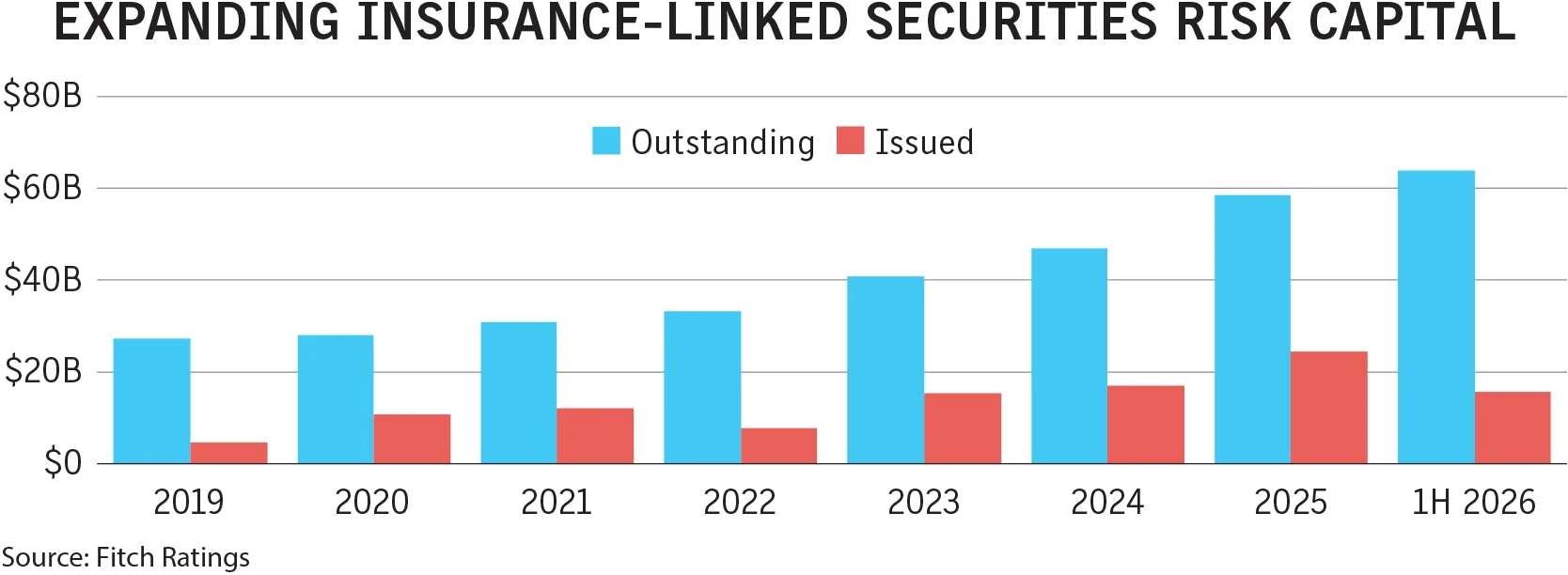
Alternative capital has grown into a substantial source of reinsurance capacity, and its reach is starting to extend beyond the property catastrophe risks that built the market. The shift brings cedents more ways to finance risk, while testing whether investors can accommodate the longer claims timelines and liquidity demands of liability business.
Richard Pennay, CEO of Aon Securities, Aon’s insurance-linked securities business, puts the market at $145 billion, or about 18% of total reinsurance capital. He said it has grown at an average annual rate of about 6.5% over the past decade and about 13.5% over the past three years. Those figures point to a rapidly expanding pool of capital, even as its established use remains concentrated in property.

More capacity and longer-term cover
Catastrophe bonds and other alternative structures have typically taken positions high in reinsurance towers, where they cover low-frequency, high-severity events such as U.S. named windstorms and hurricanes. That positioning reflects the appeal of risks with defined triggers and the potential for large losses, but market conditions are changing where some bonds attach.
“Historically, alternative capital lived almost exclusively at the top of catastrophe excess-of-loss towers through Rule 144A cat bonds,” said Terry McLean, president and CEO of SageSure, which uses ILS-based protection in its reinsurance program. “Over the past year, with record capital inflows and compressing spreads, we are now seeing cat bonds attaching lower in reinsurance towers.”
Niraj Patel, head of alternative capital for Axa XL, described cat bonds as generally focused on “more remote risk — more low-frequency, high-severity type of risk.” Their movement lower in towers suggests that abundant capital and tighter spreads are supporting a broader role in placements, though the underlying risk profile remains central to investor appetite.
For cedents, the value goes beyond adding another source of limit. Alternative capital responds to different market dynamics from traditional reinsurance, said Laurent Rousseau, CEO of global capital and advisory and head of international at Marsh Re. Capital markets investors provide a deep pool of capacity, according to Mitchell Rosenberg, co-head of global ILS at Howden Capital Markets & Advisory.
That added capacity can improve price competition and diversify counterparties, Patel said. Rosenberg described the core benefit as “optionality … providing more ways to finance and transfer risk,” with a broader mix of capital sources supporting capacity, pricing, certainty and resilience through market cycles. Terry McLean also said alternative capital can help where traditional reinsurers apply strict limits to geographic concentration.
Buyers can use that capacity to put competitive pressure on their overall reinsurance programs, said Zach Breslin, capital markets leader for Lockton Re Capital Markets. Supply has expanded enough to absorb as much as 20% across reinsurance placements and then renew, Rousseau said. In some parts of the United States, Aon sees cedents placing more than 25% of their total reinsurance purchase in catastrophe bonds, Pennay said.
Multi-year terms are another draw. Catastrophe bonds can secure three or four years of coverage, reducing the amount of capacity a cedent must replace in annual renewals. Breslin said locking in multi-year pricing and capacity can hedge against changing costs and availability in the reinsurance market, smoothing some of the volatility in annual program placement.
Jason Bolding, CEO of Gallagher Securities, Gallagher Re’s ILS division, said that when a catastrophe bond covers a large portion of a tower, the cedent needs to find less limit to complete the rest of its program. “Now you’re looking for less limit than your whole entire tower because you have this cat bond program that covers a big portion of your tower,” he said. “We’ve seen that play out multiple times.”
Casualty growth faces a different risk profile
The next area of expansion is liability reinsurance. Pennay said that in the past 18 to 24 months, the market has seen a clear expansion of sidecars, including whole-account and casualty-based structures. Bolding said more cedents are exploring alternative capital for casualty business.
That growth faces a more difficult underwriting and funding equation than property catastrophe risk. Liability losses can take years to emerge, and ultimate costs may shift with changes in the legal and social environment, according to a September report from A.M. Best. The delay makes it harder for investors to estimate final losses and determine how long their collateral may remain committed.
Patel said longer-tail lines require investment modeling that accounts for collateral being held over an extended period. Rosenberg likewise pointed to greater reserving, duration and liquidity considerations in casualty and other long-tail business. My read is that growing investor interest marks an opening for these structures, while the time value and availability of capital will remain central constraints.
Claims timing can leave capital tied up
Alternative capital structures generally require investors to post collateral in advance to cover potential losses. After a major catastrophe, that collateral can remain tied up beyond the contract term while loss estimates and claims develop. The risk was visible after hurricanes Harvey, Irma and Maria in 2017, when some investors could not redeploy their capital until losses were resolved. Similar problems followed Hurricane Ian in late 2022, McLean said.
“Cat bonds and collateralized covers face extension periods and trapped collateral if loss estimates take months or years to develop, a friction absent in traditional, unsecured treaties,” McLean said. Bolding said the possibility of trapped capital will remain because losses can take time to crystallize.
Some catastrophe bond features can make claims handling more predictable. Rule 144A bonds, which account for most of the market, use a predetermined claims process intended to reduce friction and disputes, Breslin said. He described the products as highly structured, with a transparent claims and recovery process operated by independent third parties.
For property placements, that structure has helped alternative capital become a meaningful part of reinsurance buying, including through multi-year coverage and capacity lower in towers. The test ahead is whether casualty structures can price and manage the extended uncertainty around reserving, collateral duration and liquidity. As those deals develop, the balance between additional capacity and the time investors must commit it will shape how far alternative capital can spread across reinsurance.

Discussion
Sign in to join the discussion.