Companies are testing event contracts to offset freight, tariff and weather exposure, though liquidity and payout mismatches limit their reach.
For businesses exposed to volatile freight rates, tariffs or weather, prediction markets are starting to offer a way to transfer risk that conventional insurance and derivatives may not cover. The appeal is flexibility: a company can take a position on a defined event as conditions change, rather than relying only on coverage priced well in advance. The trade-off is uncertainty over whether the market can absorb the position and whether its payout will match the company’s actual loss.
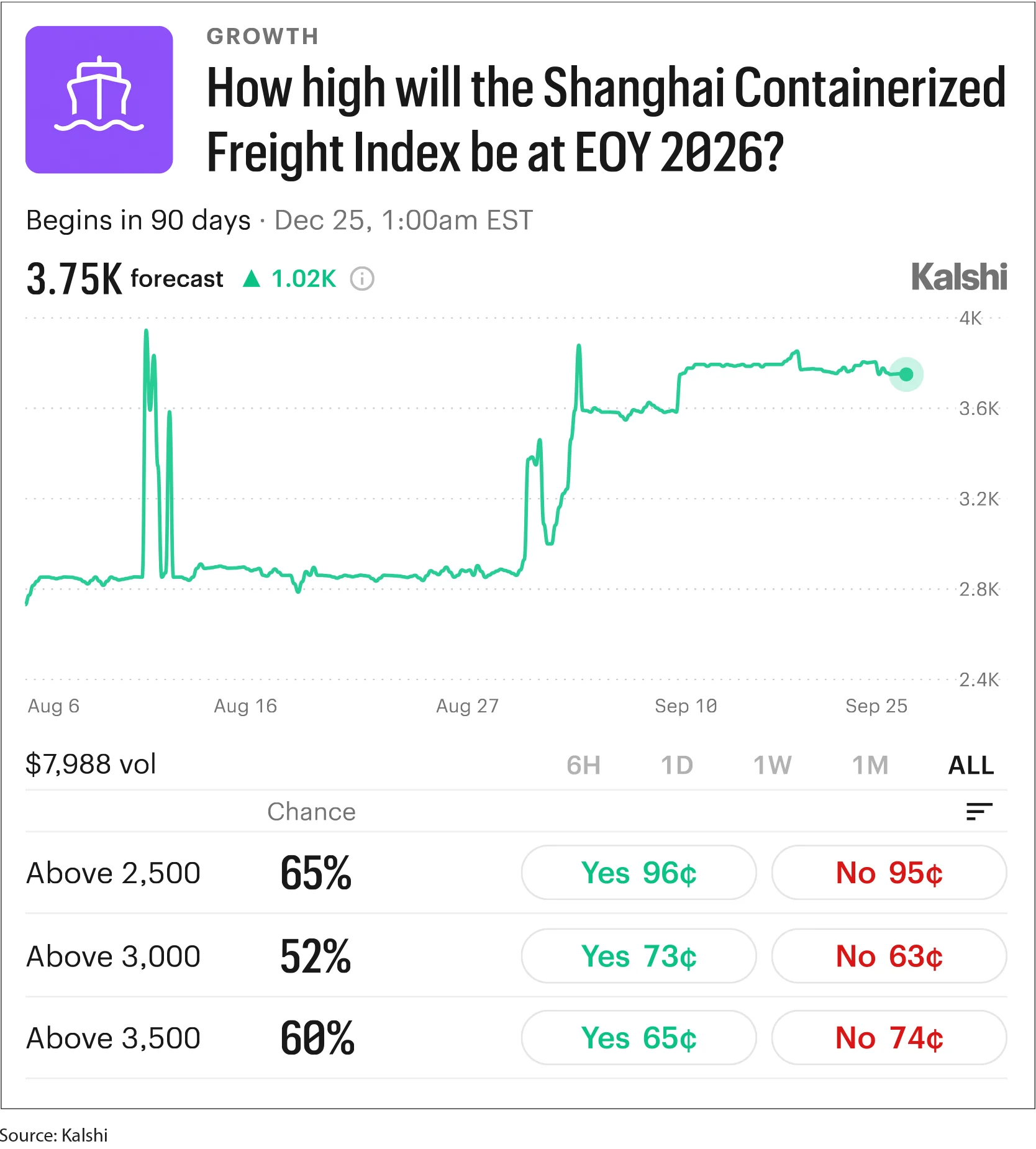
James Fayal, whose Baltimore-based company Zest sells Asian tea worldwide, has used Kalshi contracts to address two of those exposures. A successful position on whether President Donald Trump would impose a tariff on Canada paid out after the tariff was levied, helping offset some lost sales to a Canadian customer. Fayal later worked with Kalshi to develop a contract linked to a Shanghai shipping index. It pays if container shipping costs cross specified thresholds, offering a potential cushion when freight becomes more expensive.
The use cases extend beyond international trade. Kalshi says businesses have tested contracts tied to rainy days that could cancel kayak trips, cold weather that could reduce ice cream sales, and extreme heat that could damage crops sold through an online farmers market. These examples point to a market for risks that can materially affect a small operator’s revenue but may not fit readily into standard insurance coverage.
Event contracts bring risk transfer closer to real time
Kalshi contracts resolve to either $1 or $0 depending on whether a specified outcome occurs. A correct position pays $1, with the trader’s profit determined by the purchase price and fees; an incorrect one loses the amount invested. Traders can also buy or sell contracts before the event is settled. That structure makes the outcome and maximum loss relatively clear, while leaving the economic value of the hedge dependent on how well the event tracks the business exposure.
Kalshi was founded in 2018 by Tarek Mansour and Luana Lopes Lara, who had worked at firms including Goldman Sachs, Citadel and Bridgewater. Mansour’s experience building derivatives for clients seeking protection from the 2016 Brexit vote helped shape the idea for a platform where users could trade directly on events, according to Nicolas Hull, the company’s head of business development.
The platform is widely associated with sports, but its contracts also cover politics, commodities, economics and finance. Kalshi has added block trades, which let counterparties negotiate large private transactions for execution on the exchange. The facility is limited to eligible contract participants and requires at least 25,000 contracts. Kalshi has also published examples of how companies in real estate, retail, health care and other sectors might use block trades to hedge exposures.

ForecastEx, operated by Greenwich, Connecticut-based Interactive Brokers, offers event contracts tied to severe and less severe weather. Patrick Brown, the company’s head of climate analytics, describes the contracts as a more straightforward structure than traditional weather derivatives, with price discovery he considers more efficient than parametric insurance.
Weather contracts can be used as a position changes over time. ForecastEx allows customers to trade on wind gusts within a 10-kilometer radius of dozens of U.S. population centers as a storm approaches, Brown said. A business expecting a storm to affect its area could potentially use a payout toward its property insurance retention. The contract would add a market-based source of recovery, though it would not by itself establish that the payout corresponds to the business’s property damage.
That timing is part of the case for event markets. Robert Hartwig, director of the Risk and Uncertainty Management Center at the University of South Carolina, says they let businesses hedge as conditions develop. An insurer, by comparison, generally has to set rates months ahead of the period it will cover. Hartwig described a classroom experiment in which he took a large deductible on wind coverage for his home and then successfully bet on Kalshi that hurricane activity would be below normal that season because of El Niño. He said he had more information as hurricane season approached than insurers had when setting rates.
Market signals and new sources of capacity
Risk managers may also find the contracts useful as indicators, without taking a position. Michael Gruetzmacher, Aon’s head of alternative risk, said markets can provide feedback on significant events that are difficult to insure, such as the outcome of midterm elections. For companies weighing exposure to a political or economic event, market pricing may offer one additional input into internal risk assessments.
Insurers can be reluctant to cover regulatory, legal or supply chain exposures when those risks are systemic or difficult to model, said Tom Markovic, Marsh’s New York-based global head of parametric solutions. Markovic sees prediction markets as a possible route to capital from participants such as hedge funds, which may take positions for profit. That could expand the pool of money available to absorb certain risks. It doesn’t establish that the market will provide coverage at the scale or terms a particular company needs.
Fayal’s comparison captures the gap between corporate hedging tools and the options available to smaller firms. He said a large company such as Procter & Gamble could arrange forward contracts across a thousand containers to lock in freight costs, a step that isn’t readily available to a small business owner. His experience running a consumer products company with heavy freight and international supply chain exposure since 2021 has pushed him to look for alternatives.
Liquidity and payout fit remain constraints
The central commercial concern is basis risk: a contract can pay according to its stated terms while failing to compensate for the loss a business actually incurs. A rise in interest rates, for example, may affect companies differently depending on their financing, customers and operations. Rob Hoyt, a risk management professor at the University of Georgia, said it can be difficult to predict how an economic event will affect a specific business. Insurers, by contrast, make a business of estimating the financial impact of adverse events.
Liquidity and market reliability also shape whether event contracts can serve as repeatable corporate hedges. A company needs to know whether it can enter and exit a position at useful prices and whether the market will resolve the contract as written. Kalshi and Polymarket have faced allegations of insider trading and manipulation. Kalshi has canceled contracts over ambiguity in rules concerning the length of the 2026 government shutdown, the timing of the death of Iran’s Ayatollah Ali Khamenei and rapper Cardi B’s Super Bowl appearance. Polymarket has faced questions about its UMA dispute mechanism. Several states have sought to shut down Kalshi, arguing that it operates as a sports betting site requiring a gaming license.
That record sits uneasily beside the certainty businesses expect from insurance payments. Nick Martin, Alliant’s Atlanta-based alternative risk transfer lead, framed the issue as whether users can feel certain that a payment will arrive and cover the downside they intended to transfer.
For now, prediction markets look most useful as a targeted tool for exposures that are hard to insure, or as a source of real-time information for risk teams. Their value will depend on the fit between the contract’s defined outcome and the company’s actual losses, as well as the depth and reliability of the market when a business needs to trade.

Discussion
Sign in to join the discussion.