Leavitt Group, Scott Insurance and Davidson & Associates lead the 2026 rankings, where top employers also posted stronger employee engagement scores.
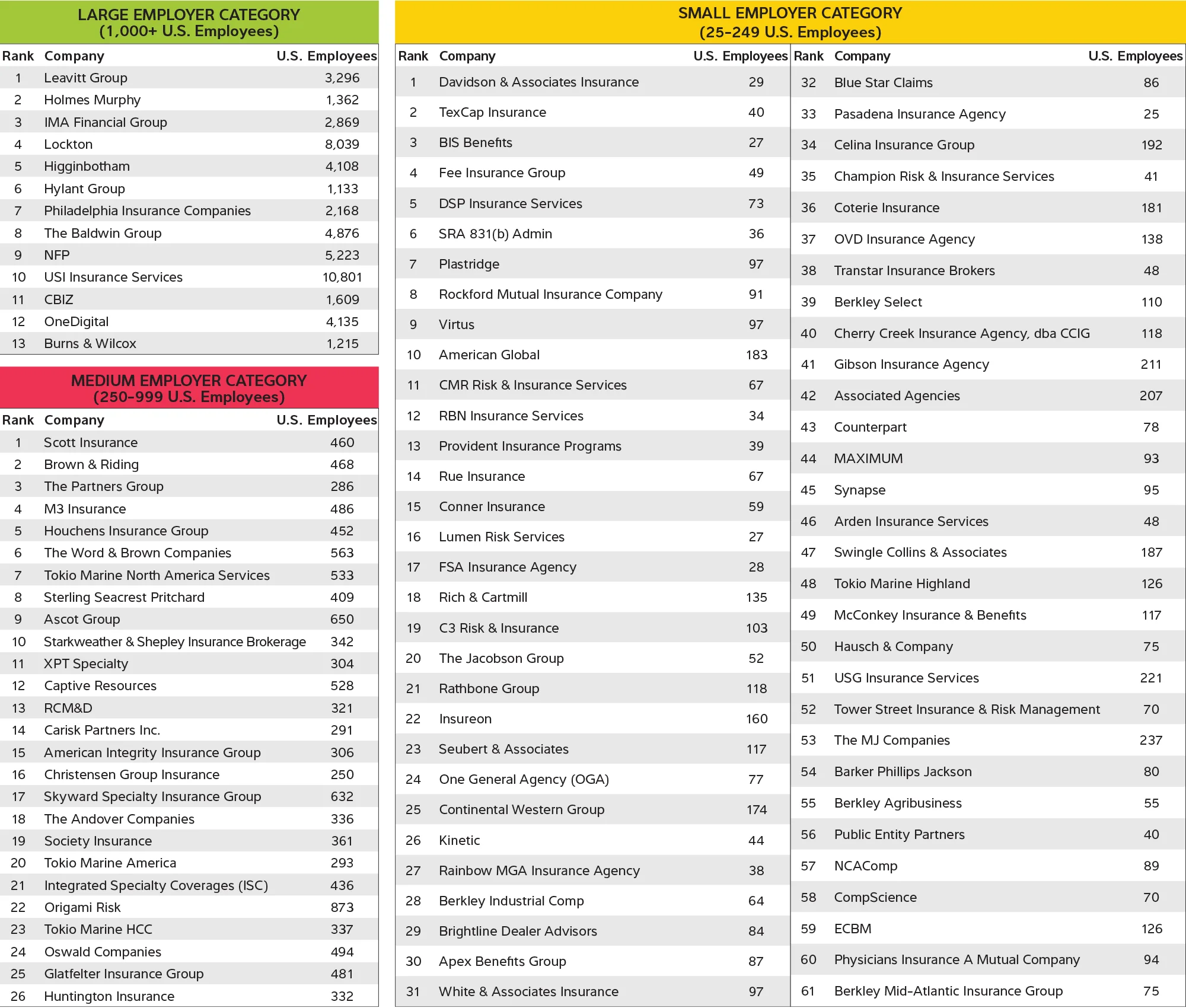
The 2026 Best Places to Work in Insurance rankings point to a talent strategy with measurable stakes: employers that made the list scored higher than other participating firms across leadership, development, compensation and engagement. Leavitt Group, Scott Insurance and Davidson & Associates Insurance topped the three employer-size categories, while flexibility, paid time off and employee development recur among the reported workplace features.
Presented annually by Business Insurance and Best Companies Group, the program recognized 100 insurance companies ranging from 25 employees to more than 10,000. Best Companies Group, based in Harrisburg, Pennsylvania, assesses organizations through an employer questionnaire covering policies, practices and demographics, alongside a confidential employee survey. Results are analyzed across eight areas, from leadership and workplace culture to pay, benefits and engagement.

Winners span agency sizes and business models
The rankings group employers by U.S. headcount: small companies have 25 to 249 employees, medium companies have 250 to 999, and large companies have at least 1,000. Leavitt Group won the large employer category, Scott Insurance led the medium category, and Davidson & Associates Insurance ranked first among small employers.
Leavitt Group, a privately held brokerage headquartered in Cedar City, Utah, has more than 3,200 employees and operates through over 290 locations in 31 states. Its business includes commercial insurance, employee benefits and personal insurance. The firm describes its model as pairing national resources with local relationships: its agencies retain local ownership and leadership while drawing on the broader organization. The company has served clients, communities and employees for more than 70 years. Employees cited flexibility, connection and professional development as valued parts of its people-focused culture.
Holmes Murphy, based in Waukee, Iowa, placed second among large employers. The independent brokerage provides risk management and benefits consulting and employs more than 1,300 people. Its workplace message, “love what you do and who you do it with,” reflects an emphasis on individual contributions. Denver-based IMA Financial Group took third. Its more than 2,800 employees highlighted work-life balance, unlimited personal days, flexible work-from-home schedules and a social workplace.
Scott Insurance’s first-place finish in the medium category puts employee ownership at the center of its profile. Founded in Lynchburg, Virginia, in 1864, the independent agency is 100% employee-owned and has more than 400 employee owners. It provides services in property and casualty, employee benefits, captives and surety bonds. Employees pointed to hybrid work, company-sponsored development and celebrations for employee owners as features of the workplace.
Dallas-based Brown & Riding ranked second among medium employers. The wholesale brokerage is owned internally by its producers and executive leadership, and its more than 400 employees cited flexible schedules and benefits. The Partners Group, an insurance, consulting and financial services firm based in Portland, Oregon, placed third. More than a third of its employees are shareholders. Reported office amenities include fitness classes, summer cold brew and kombucha on tap, a game room and relaxation areas.
Davidson & Associates Insurance, headquartered in Vancouver, Washington, won the small employer category. The independent brokerage has 29 employees and has operated under local ownership for more than 30 years, serving the community through personal, commercial and life and benefits insurance. Employees highlighted work-from-home flexibility, unlimited paid time off, paid family medical leave and an annual company-sponsored beach retreat. The firm also has a pet-friendly office.
TexCap Insurance, an independent commercial agency in Dallas, was the small-category runner-up. It serves small businesses, middle-market companies and niche industries. Employees cited holiday events, team-building activities and volunteer opportunities. Roswell, Georgia-based BIS Benefits, a group health and business insurance brokerage, ranked third. It offers an annual wellness stipend, unlimited paid time off and early-close Fridays. Its stated approach is that caring for employees supports the company’s work.
Category results extend beyond brokerage firms
Rockford Mutual Insurance Company took first place in the Insurers/Providers category. The Rockford, Illinois-based insurer offers home, auto, business and farm coverage and employs 91 people. Its workplace activities include monthly events and office Olympics; employees also cited an open-door policy, casual dress and a week of customer service appreciation activities with games, meals and prizes.

Davidson & Associates also won the Agents/Brokers category, adding an industry-category win to its small-employer result. The firm marks employee birthdays and work anniversaries with gifts and holds team events every two months, including happy hours, picnics and bowling. Employees particularly value “Fun Fridays,” which provide one paid Friday off each month.

Engagement scores show the largest gaps in development and leadership
The workplace examples come against a backdrop of workload strain. A 2025 industry survey cited in the report found that 51% of independent agency employees felt burned out, 87% said their workload had increased over the prior year, and nearly four in 10 frontline employees were considering leaving their jobs. In that context, talent retention depends on more than recruiting: the rankings suggest that employees respond to the way employers manage work, communicate and create room to grow.
Across the eight survey areas, the clearest differences between recognized employers and those that did not make the list appeared in leadership and planning, and in training and development. Among top employers, an average 90% of surveyed staff responded positively about understanding company strategy, trusting leadership and believing leaders were open and attentive to employee well-being. The comparable result for other companies was 76%.
For training, development and resources—including onboarding, ongoing instruction, reliable equipment, advancement opportunities and recognition for good work—87% of employees at top employers responded positively, versus 73% at other firms. Culture and communication also showed a 13-point gap: 88% positive responses at top companies compared with 75% elsewhere. Those measures cover clarity, trust, cooperation, feeling valued and diversity.
Role satisfaction registered 90% positive responses among employees at top employers, compared with 80% at firms outside the list. That category includes autonomy, work-life balance and feeling valued. Compensation and benefits had a smaller difference: 85% positive at top employers and 79% at other companies, covering perceptions of fair pay and satisfaction with paid leave, health insurance and retirement plans.
Work environment and supervisor relationships were high-scoring areas across both groups, with narrower gaps. Positive responses on physical conditions, comfort and safety averaged 93% for top employers and 91% for other firms. Supervisor fairness, respect, trust and openness to feedback drew 93% positive responses at top employers, against 90% elsewhere. On engagement—including job satisfaction, purpose and pride in the company—the figures were 92% and 81%, respectively.
The pattern is consistent with the reported employee benefits: flexibility and time off feature prominently, but the strongest score gaps also involve communication, leadership confidence and development. For insurance employers managing elevated workloads, those are practical areas to watch as they compete to keep experienced staff.
Participation criteria and 2027 program
To qualify for the program, an organization must be a for-profit or nonprofit business, be publicly or privately held, operate a U.S. facility, employ at least 25 people in the United States and have been in business for at least one year. Eligible organizations include retail agents and brokers, wholesale brokers and managing general agents, reinsurance intermediaries, claims services companies, benefits brokers and consultants, property and casualty insurers, group life and health insurers, reinsurers, and qualifying nonprofit insurance associations or service organizations.
Organizations interested in the 2027 program can contact Susan Stilwill at [email protected] or 312-636-7222, or visit www.BestPlacesToWorkIns.com.
View the Best Places to Work overall rankings (1-100) here.
1 Liberty Mutual Insurance, “Burnout 2025,” accessed Aug. 11, 2026.

Discussion
Sign in to join the discussion.