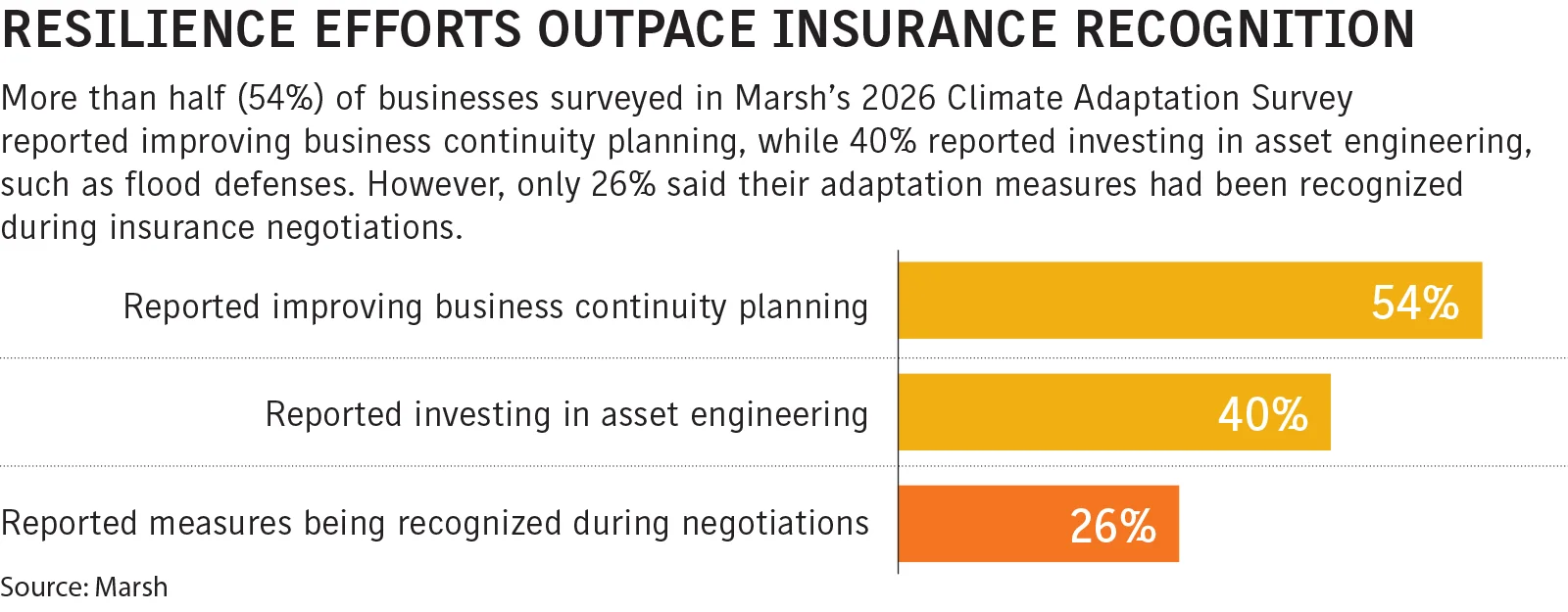
Resilience work can attract insurance capacity and improve terms, but only 26% of surveyed organizations said insurers recognized their adaptation efforts.
Property resilience can strengthen an owner’s position with insurers, but the financial return rarely follows a simple formula. Better-prepared properties may attract more capacity and support negotiations over deductibles and coverage; direct premium credits for individual upgrades remain inconsistent.
That distinction matters in a competitive property market. Blake Giannisis, executive vice president and North American property practice leader at Hub International in New York, said resilience can make a risk more attractive to insurers. More capacity can then increase competition and put downward pressure on costs, though a single improvement doesn’t guarantee a corresponding premium reduction.
Insurers’ recognition of adaptation efforts appears limited so far. In Marsh’s 2026 Climate Adaptation Survey, released in September, only 26% of more than 120 organizations worldwide said their work had been recognized during insurance negotiations.

Resilience as a negotiating advantage
Prologis has tightened construction specifications across its development work, extending the expected lifespan of some roofs from 20 years to 30, said Jeff Bray, the San Francisco-based logistics real estate company’s senior vice president and head of global risk management. “We are using products that are intended for a longer, more durable life cycle,” he said.
The company owns and develops about 6,000 properties in 20 countries. In some years, it has also spent millions of dollars voluntarily retrofitting properties exposed to earthquakes, aiming to limit damage and disruption for customers.
Bray said he couldn’t identify direct premium savings across the portfolio from the seismic work. He described the investments as “a strong signaling tool” that shows underwriters Prologis is reinvesting in its properties and becoming a better risk. In his view, that can help the company negotiate for capacity, deductibles and coverage terms.
Prologis also raises operational measures, including disaster response and backup power planning, in discussions with insurers. But insurers don’t consistently record those measures as data points, Bray said. He was named the Risk & Insurance Management Society’s 2026 Risk Manager of the Year earlier this year.
For AXA XL, resilience has value in both hard and soft insurance markets. Raymond Chiusano, the insurer’s New York-based head of property for the East zone, said preparation can reduce losses, speed recovery and limit downtime, while potentially helping a business secure more stable capacity over time.
Risk engineers and insurers work with policyholders on changing exposures and ways to address them, from physical property improvements to emergency response and disaster recovery planning. For health care organizations, water damage prevention and response are key concerns. Life sciences companies and manufacturers can focus on supplier screening, alternative sourcing and buffer inventory to manage supply-chain risks.
Chiusano also pointed to leak sensors and water-flow technology that flags abnormal usage. “If an insured is proactive with those items of resilience, I’m more willing to put out more capacity,” he said.
Turning mitigation into measurable risk
Risk models can complicate efforts to translate resilience into insurance terms. Catastrophe models may account for some property-level measures, but community-level work can be harder to quantify, said Kim Roberts, Marsh Re’s head of North America peril advisory, based in Fort Collins, Colorado.
“We need to be able to speak the language of reinsurance and insurance, and translate these actions into measurable metrics,” Roberts said at a Marsh-sponsored panel during Climate Week NYC in September.
There are examples of insurers recognizing specific mitigation work. Last year, The Nature Conservancy and Willis Towers Watson developed a $2.5 million wildfire policy for the Tahoe Donner homeowners association in California. A specialty managing general agent assessed risk reduction from forest management, including tree thinning and prescribed burns. The resulting policy had a 39% lower premium and an 84% lower deductible than it would have had without the resilience work, said Deborah Glaser, the Nature Conservancy’s Los Angeles-based project director for disaster resilience.
Catastrophe models can reflect many property features when detailed building data is available, said Glen Daraskevich, executive vice president at Boston-based modeler Karen Clark & Co. Depending on the peril, inputs can include roof cover, glass type and building elevation, which can affect estimates ranging from expected losses to probable maximum losses.
The information has to travel from risk managers to insurers and into the models, Daraskevich said. Model updates also matter: newer mitigation work may not be reflected if the tools haven’t been updated. Some models can include community flood and wildfire measures when reliable information is available.
Multiple mitigation steps can produce double-digit changes in modeled losses, Daraskevich said, although the effect depends on the hazard and other factors. For property owners, the practical case for resilience may therefore rest on a mix of reduced disruption, stronger insurance negotiations and model-recognized risk reduction—not a guaranteed credit for each upgrade.
Gavin Souter contributed to this report.

Discussion
Sign in to join the discussion.