Opioid prescribing has declined, but rising pharmacy costs and uncertain recovery gains put treatment outcomes, coordination and long-term claims under scrutiny.
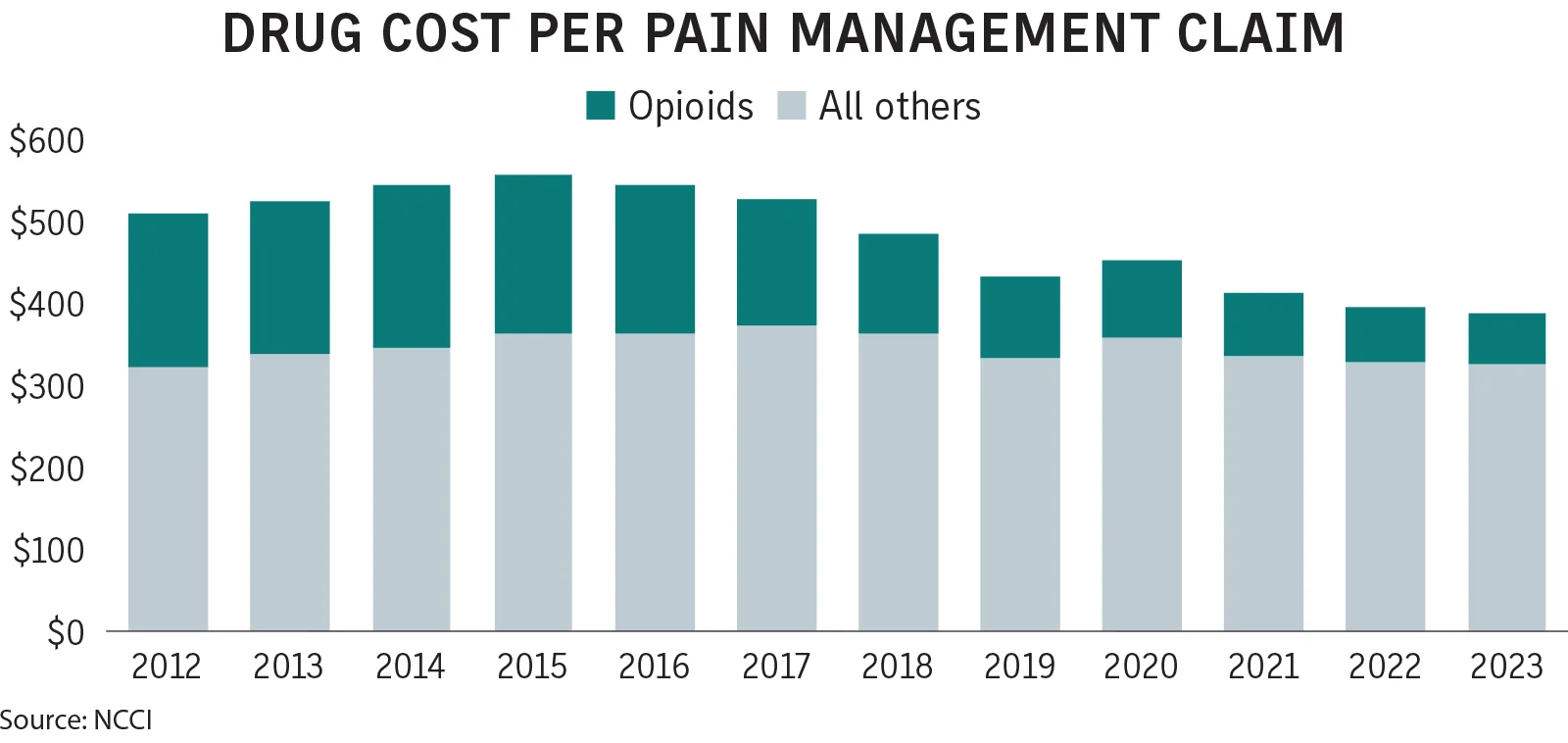
Workers compensation has made measurable progress in reducing opioid use. The next test is whether injured workers are recovering faster and returning to work, while the broader mix of pain treatments avoids new costs and medication risks. The available data shows a clear prescribing shift; it offers less certainty about what that shift means for function and claim outcomes.
In Enlyte’s analysis of retail and mail-order pharmacy transactions billed through its workers compensation pharmacy benefit management program, opioids made up 19.8% of prescriptions in 2025, down from 30.1% in 2016. The average daily morphine-equivalent dose per opioid prescription also fell 35.6% over that period.
That change reflects a decade of expanded pharmacy review, nurse case management and treatment options such as physical therapy, behavioral care and topical medications. But pain remains a substantial part of both medical care and claims economics. Jon Sinclair, executive director and actuary at the National Council on Compensation Insurance in Boca Raton, Florida, said pain management accounts for about 30% of annual workers compensation medical costs. He said the sector has broadened its treatment mix without finding a single replacement for opioids.

Prescribing gains outpace outcome evidence
The business case for better pain care reaches beyond pharmacy spend. Pain management can shape recovery, a worker’s ability to resume a job and the total cost of a claim, said Ramona Tanabe, president and CEO of the Workers Compensation Research Institute. WCRI began studying the issue in part because opioid prescribing varied across states. Changes in prescribing rules, guidelines and utilization management have since created further questions for researchers.
For now, the industry has stronger evidence that opioid use has declined than that return-to-work outcomes have improved, said Dr. Scott Cherry, chief medical officer of Houston-based Axiom Medical. Employers should compare disability duration by diagnosis and across treatment approaches. “The most important thing is function in each injured employee,” he said.
That focus changes how success is measured. Michael MacAulay, president of Mount Laurel, New Jersey-based Lodestar Claims & Risk Services, said effective pain management should support a quicker return to work, lower total claim costs and better outcomes for the worker. Those aims can pull costs in different directions at first: physical therapy may cost more than a prescription, but earlier work resumption and fewer indemnity payments can alter the claim’s total economics, said Emily Drew, president and CEO of Helmsman Management Services, Liberty Mutual Insurance’s third-party administrator. “You also have to look at something other than pure cost,” she said.
Policy and claims practices have also shifted. Sixteen states have drug formularies for injured workers, according to WCRI, while many states use prescribing limits or controlled-substance tracking. A study published in Addiction in 2021 found that the number of states with laws limiting opioid prescribing or dispensing rose from 10 in 2016 to 39 by the end of 2019.
The CDC’s 2016 guideline addressed primary care prescribing for chronic pain outside active cancer treatment, palliative care and end-of-life care. Although voluntary, its recommendations influenced policies adopted by governments and payers. The CDC’s 2022 update covered acute, subacute and chronic pain in adult outpatients and cautioned against turning dosage guidance into rigid limits or abruptly ending treatment.
That clinical distinction can get lost when claims processes rely on fixed authorization thresholds, Cherry said. A recommendation intended to guide care may become an inflexible coverage decision if the worker’s circumstances are not considered. Joe Paduda, president of Skaneateles, New York-based CompPharma, said maintaining the programs and clinical approaches that reduced inappropriate prescribing remains necessary. The challenge is to pair those controls with closer measurement of what happens when opioids are reduced or avoided.

Alternative treatments bring their own cost questions
Lower opioid payments have not meant lower pharmacy costs across the board. WCRI examined prescriptions filled within three years of injury on non-COVID-19 claims in 31 states. Between the first quarters of 2022 and 2025, prescription payments per medical claim rose in most of the states studied, even as per-claim opioid payments declined in nearly all of them.
Dermatological agents made up 23% of prescription payments in the median state in early 2025, and more than 30% in 12 states. In 20 states, physician dispensing and delivery pharmacies accounted for more than 70% of dermatological payments.
Nikki Wilson, senior director of clinical pharmacy services for Omaha, Nebraska-based Enlyte, sees both useful care and questionable spending in the search for opioid alternatives. Topical medications can make sense when evidence supports them and they suit the condition. The concern is a higher-priced product that brings no added clinical value, including new strengths of familiar drugs such as ibuprofen and gabapentin. “If you’re going to have a new drug, make sure it’s got efficacy,” she said.
Medication review also needs to account for the full regimen. Replacing an opioid with separate prescriptions for pain, muscle spasms, sleep and anxiety can leave a worker taking several drugs that require close oversight, said Scott Westman, senior vice president and chief claims officer of Lodestar in Jacksonville, Florida. Reviewers also need to consider medications the worker takes outside the claim.
Regular contact with workers and prescribers can reveal when a treatment is no longer being used or needs reassessment, said Mina Nakhla, assistant vice president of pharmacy and ancillary programs for Philadelphia-based Gallagher Bassett. Topical medications may sit unused, while long-term use of other drug classes can warrant a fresh review.
Care coordination shapes recovery
Some treatment plans may be simplified when providers coordinate. For a worker with nerve pain and depression, a pharmacist might discuss with the pain provider and psychiatrist whether one medication could address both conditions, said Andrew Newhouse, director of clinical pharmacy for Sedgwick in Rochester, Michigan. “We’re treating the workers more as a whole versus just focusing on opioids,” he said.
That broader view includes the psychological effects of injury. Being unable to work can affect a person’s sense of self-worth, Newhouse said. Jen Laabs, claim director for workers compensation at Church Mutual Insurance in Merrill, Wisconsin, said concern about accepting an additional condition on a claim has historically made behavioral and psychological issues uncomfortable territory for insurers. That concern should not prevent attention to factors that affect recovery.
Workers with similar physical injuries may need different support. An underlying health condition or responsibilities such as caring for a disabled child can change how someone experiences treatment, said Taylor Kostroski, Church Mutual’s senior nurse case manager for workers compensation. Education and advocacy can help injured workers understand their options and take part in care, she said.
Claims administrators are also using predictive models to flag cases with potential for prolonged disability, chronic pain or excessive pharmacy use, MacAulay said. At Helmsman, tools can direct relevant information to adjusters managing more than 100 files, helping them identify claims that may need consultation or earlier support, Drew said. Westman said the industry needs to act more consistently on the information these models provide.
Support can start at the workplace. A supervisor’s early check-in may help keep a worker connected to the job without probing into medical details, Cherry said. Case managers can coordinate that contact and help bridge gaps among the worker, employer and treating providers. The practical measure is whether care helps the injured person regain function and return to daily life.
Long-term opioid claims need individual plans
Workers who have taken opioids for years present a different challenge from newly injured workers. Some legacy claims involve persistent pain, multiple surgeries and medication plans established before current prescribing controls. Their care may require coordination among treating physicians, pain specialists, pharmacists, nurses and behavioral health providers.
Long-term opioid use can cause physical dependence, but dependence by itself does not establish addiction or opioid use disorder, according to the CDC. Some workers who began older claims on high doses have reduced their use without reaching a point where they can stop treatment entirely. “Overall, we may not be able to get them completely off the opioids, but can we get them to the next lower level if they’re doing better?” Newhouse said.
Age and other health conditions can complicate established regimens. A worker taking medication for diabetes or high blood pressure may face additional interactions or adverse effects when treatment changes, Newhouse said. Before changing pain medication, providers need to understand why the pain persists, said Dr. Frank Tomecek, medical director of Tulsa, Oklahoma-based Precision Motion Health and a neurosurgeon. “Pain is not a diagnosis, it’s a symptom,” he said.
Persistent symptoms after back surgery, for example, may call for evaluation of an unresolved or new structural problem. Other workers may need a pain specialist, physical reconditioning and additional care. Cherry said abruptly ending coverage before another treatment is available can leave a worker without support. The treating provider should guide the plan, claims staff should arrange timely authorizations, and case managers should coordinate the transition.
The CDC’s 2022 guideline advises against abrupt discontinuation or rapid dose reductions unless a life-threatening concern exists. It calls for tapering that reflects the patient’s circumstances, which can take months or years, and for weighing tapering risks against the risks of continued treatment. Behavioral and nonopioid therapies can be part of that plan.
Older claims may need more frequent reviews, nurse involvement and patient education, Nakhla said. Workers can be wary of trying another treatment, and Wilson said changing a regimen becomes difficult after years of use. For people already on long-term medication, better daily function may be a more useful near-term goal than complete discontinuation, Newhouse said. Regular medication review, support for activity and evidence about what is helping can keep the treatment plan tied to the worker’s progress.

Discussion
Sign in to join the discussion.