Senior care claim payments are climbing while excess coverage costs more, pushing operators to strengthen controls and retain more risk.
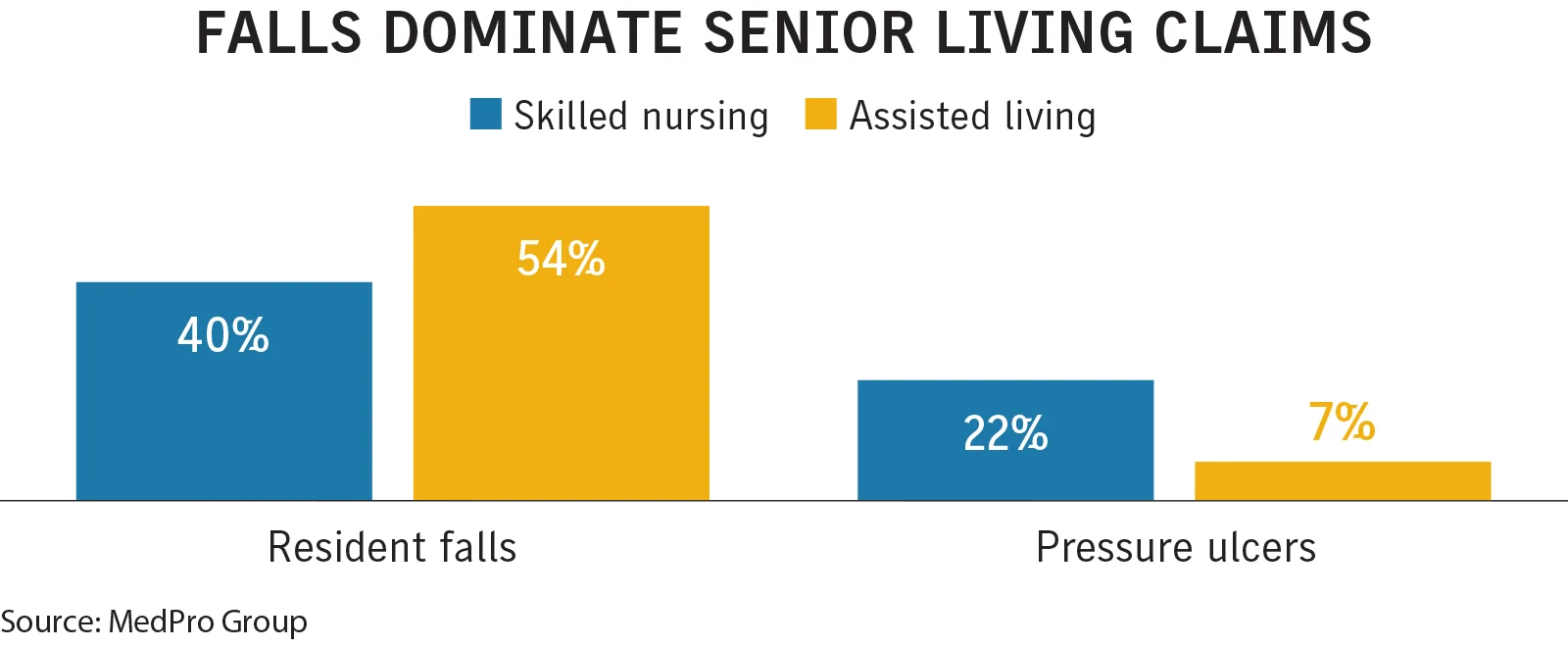
Senior living operators face a widening gap between rising claim costs and the price of liability protection. Primary coverage remains comparatively steady for operators with strong loss records in favorable jurisdictions, while excess insurance is getting more expensive and harder to assemble. At the same time, claims that once settled for modest sums are now consuming substantially more capital.
The pressure reaches assisted living, memory care and skilled nursing providers caring for residents with increasingly complex needs. Falls and pressure injuries remain common sources of claims. Allegations of abuse or neglect and incidents in which residents leave supervised areas occur less often, but can produce especially severe losses.

Claim severity is changing the cost base
After a short post-pandemic lull, claim severity rose sharply from 2023, said Blaine Thomas, CNA’s vice president and global health care technical underwriting and product development leader, based in Bloomington, Minnesota. Medical inflation and litigation dynamics, including large jury awards, are lifting claim values.
The strain isn’t limited to headline verdicts. Thomas said claims that once resolved around $175,000 can now reach $500,000, creating what he called a “significant expense burn” for the sector. MedPro Group, a Berkshire Hathaway company, reported that average indemnity payments on senior care claims climbed to $253,000 in 2024 from $179,000 in 2019.
Memory care adds another cost dimension. In MedPro’s review of more than 2,000 claims nationally, average indemnity for memory care cases in assisted living facilities was $233,000, nearly 23% above cases without memory care exposure.

Recent verdicts illustrate the potential severity. A Sacramento County, California, jury awarded $110 million earlier this year in a case involving a 100-year-old resident with Alzheimer’s dementia who wandered outside a facility and died of hypothermia. The award included $100 million in punitive damages. DigitalBridge Group, formerly Colony Capital and a defendant, said in an Aug. 4 SEC filing that it disagreed with the verdict and intended to appeal any judgment and pursue available post-trial remedies.
In July, a federal jury in Montana awarded nearly $16 million to the families of two residents of a Billings memory care and assisted living facility in a case alleging negligent care. The award included $15.5 million in punitive damages. Koelsch Senior Communities, a defendant, is seeking to reduce those punitive awards through post-trial motions.
These cases can be difficult to defend because jurors are weighing the treatment of vulnerable people, said William J. Mundy, a health care defense attorney at Burns White in Philadelphia. Senior care claims often lack the lost wages or future medical expenses found in other bodily injury cases. Instead, plaintiffs may focus on neglect, abuse and loss of dignity. Mundy said the emotional force of those allegations can push claim values higher.
Excess towers cost more to build
Capacity is still available in the excess and umbrella market, but insurers are charging more and offering smaller limits. For large accounts, rate increases can reach 30% or more depending on tower size and the source of capacity, said Scott Wallace, Chicago-based managing director of Marsh Risk’s senior living and long-term care practice.
Where insurers once might have provided $10 million, and sometimes as much as $15 million, in a single excess layer, limits have generally fallen to $5 million, Wallace said. A $20 million tower may now need three or four insurers. Carriers willing to provide $5 million can become less comfortable as their participation rises toward $10 million, said Jack Harms, a CRC assistant vice president and broker in Boca Raton, Florida.
Benchmark Senior Living recorded about a 20% year-over-year increase in its excess liability program at its latest renewal, said Rachel Thuerk, the Waltham, Massachusetts-based operator’s vice president of risk management. Its primary program has been more stable. Benchmark operates 72 communities across nine states from Virginia to Maine, mostly outside difficult venues such as California, Cook County, Illinois, and Philadelphia.
Thuerk said another 20% or 25% renewal increase could lead the company to reconsider the size of its insurance tower. Benchmark is studying whether to establish a captive to retain workers compensation losses, with other coverages potentially considered later.
Primary pricing is generally flat to up single digits for operators with favorable loss experience in less challenging jurisdictions, said Alex Whipple, Phoenix-based senior vice president of the senior living practice at CAC, part of The Baldwin Group. California remains difficult: even an operator with a favorable loss ratio could see a $100,000 retention rise to $250,000 or face a substantial rate increase. Some smaller and middle-market operators in California are dropping excess coverage because of the cost, while larger organizations generally continue to buy it. Los Angeles and Sacramento counties, Cook County, Florida and Georgia are among the tougher markets, Whipple said.
Coverage details also matter. Abuse coverage may be available in excess layers, but operators need to confirm whether those policies follow sublimits in the primary contract. Harms warned that an excess policy may exclude the primary policy’s sublimits, leaving abuse coverage short of the full tower even when buyers expect it to extend throughout.
Thomas said primary claim severity has compounded at roughly 10%, outpacing rate increases since 2023. In his view, pricing has not caught up with the underlying loss trend.
Risk controls and ownership draw scrutiny
Operators are adding technology and hands-on training to reduce incidents and improve response. Benchmark has tested SafelyYou, an AI-powered camera system that detects falls in several memory care communities. Thuerk said footage can help staff establish whether a resident hit their head, lowered themselves to the floor or got up without assistance, informing decisions such as whether to send the resident to an emergency room.
The company has also expanded in-person training on wheelchair securement, elopement prevention, chemical security and fire safety. Thuerk said staff retain more from physical, instructor-led practice than from videos completed with a final click-through acknowledgment.
MedPro found that staffing, protocol compliance and communication problems were overrepresented in paid senior living claims of $500,000 or more. Insurers are also examining ownership and operating history, said Dan Gilhooly, managing director of Arthur J. Gallagher & Co.’s senior living practice in Rolling Meadows, Illinois. Repeated changes in ownership or management can prompt questions about leadership and staffing continuity. New equity investment may be viewed positively when it brings experienced operators and funding for the facility.
Technology can support underwriting and claim defense, though insurers have been slow to translate loss prevention tools into specific premium reductions, said Carl Swan, Phoenix-based executive vice president of CAC’s senior living practice. Some larger programs may receive $25,000 to $50,000 risk management grants for fall prevention, wound care or predictive analytics.
Retained risk and technology carry trade-offs
Captives and risk retention groups are drawing more interest as operators seek ways to manage costs. PCH Mutual, a Vermont-based risk retention group formed in 2004, serves small and midsize nonmedical residential care facilities and operates in 47 states. It commonly provides $1 million per occurrence and $3 million aggregate limits, including sexual and physical abuse coverage. CEO Julie Bordo said the organization was created for facilities that had few options for affordable, broad coverage. Members also receive risk management resources, including resident care documentation software.
Marsh Agency launched Secure Harbor in January, a group captive offering general and professional liability to skilled nursing, assisted living and senior living businesses with similar risk profiles. Domiciled in Washington, D.C., it offers limits up to $1 million per occurrence and $3 million aggregate, along with claims administration and safety consulting support.
The sector has shifted toward retaining more risk over the past decade, Thomas said. About 90% of senior living insurance premium is now connected in some way to a deductible or self-insured retention, compared with a market that once relied mainly on first-dollar coverage. Some larger operators use captives to fund retained claims, while others retain more risk because buying a full tower has become too costly. Harms said some captives are designed to fund self-insured retentions and buffer layers if claims arise.
AI use is also growing: 37% of industry professionals reported using AI-powered tools in 2025, up from 9% in 2024, according to a LifeLoop report.

Monitoring systems can document when employees enter a room after an alert and how quickly they respond, Thomas said, creating evidence that may help defend a claim. The same record can expose a missed or delayed response. Operators need staff training and consistent procedures so the technology reflects sound care practices.
Incomplete records can make claims harder to defend, Mundy said. Electronic medication administration records can prompt staff to finish required documentation before a shift ends. Other tools, such as call-bell audits, can reveal response times: an eight- to 10-minute wait may raise questions when the cited industry average is about five minutes or less.
Thomas said most liability policies don’t currently contain specific AI exclusions or limits. Coverage will generally turn on whether bodily injury occurred, what caused it and whether the operator responded appropriately. For operators, the practical test is whether staffing, training and documentation can keep pace with the risks their systems now record.

Discussion
Sign in to join the discussion.